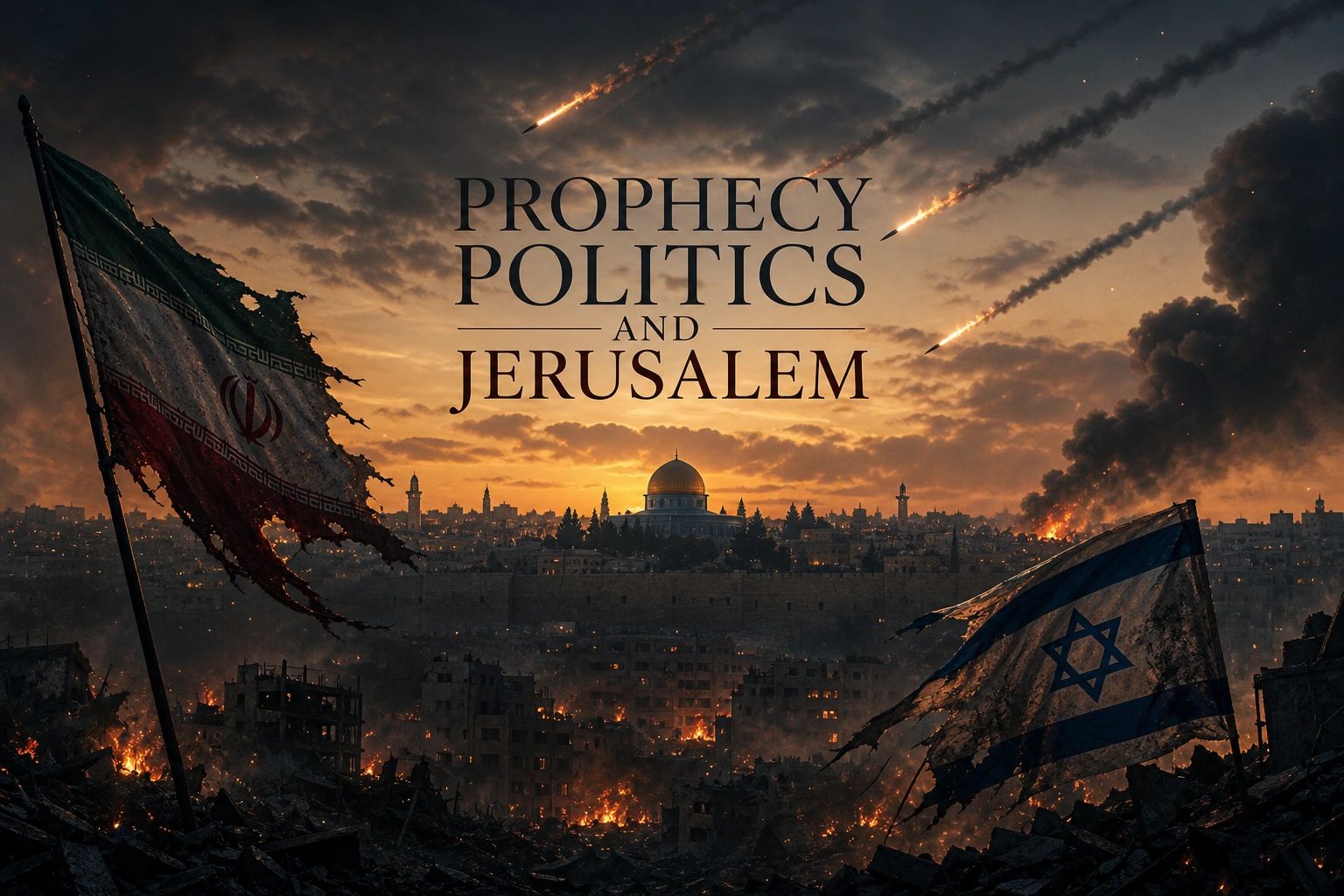
Shawn Pardazi, author of The Patriot Jihadi, writes from the perspective of a Middle Easterner who has lived inside the region’s political, religious, and cultural fault lines. In recent years, claims that Jerusalem will be liberated from Israel by 2027 have spread through Islamist media, social platforms, and war commentary, mixing end-times belief, political messaging, and regional grievance into one powerful narrative.
The 2027 claim
The “2027” claim is usually tied to Hamas founder Sheikh Ahmed Yassin and later amplified by Islamist writers and social media accounts. In the most repeated version, Yassin said Israel would no longer exist by 2027, based on a 40-year generational theory applied to modern Palestinian history.
That is not an accepted Sunni or Shia doctrine. It is a modern political-religious prediction, strengthened by numerology, wartime rhetoric, and activist interpretation.
Hamas and the Hadith
Hamas’s 1988 charter is the clearest example of this fusion of theology and militancy. Article 7 ends with the hadith that the Hour will not come until Muslims fight the Jews, and that Jews will hide behind stones and trees; the tree and stone will then call out to Muslims, except the Gharqad tree.
The text in Hamas’s charter is not a neutral citation. It is used as ideological framing for conflict, and the charter’s own language makes that clear by presenting the struggle as religious and existential rather than merely territorial. The relevant quotation is commonly traced to Sahih Muslim 2922, with parallel wording also found in Hadith collections cited in discussions of the same report.
Why that matters
This is where mainstream belief and Islamist interpretation diverge. Mainstream Sunni scholarship treats end-times narrations as eschatology, not as a standing order for political violence or a checklist for modern war.
Hamas’s use of the Hadith turns an apocalyptic tradition into a present-day rallying cry. That move is doctrinally and politically significant because it collapses the distance between prophecy and policy.
Shia end-times and Iran
Twelver Shia Islam centers on the Hidden Imam, or Mahdi, who will return to establish justice at the end of time. In mainstream Shia thought, this is a theology of waiting, patience, and divine timing, not a calendar with a set year.
Iran’s revolutionary state, especially after Khomeini, politicized that expectation. Al-Quds Day, resistance rhetoric, and the idea of active confrontation with Israel recast Jerusalem as a revolutionary duty rather than only a sacred site awaiting divine redemption.
That shift matters because it moved the conversation from passive expectation to active facilitation. In practice, it helped justify proxy warfare, militant support networks, and a permanent mobilization against Israel in the name of sacred history.
Khaybar as Symbolism
Iran’s Kheibar Shekan missile shows how explicit that symbolism has become. The missile’s name means “Breaker of Khaybar,” a reference to the Battle of Khaybar, which carries deep historical and religious meaning in the Muslim-Jewish memory of the region.
Euronews reports that Iranian state framing presents the missile with an ideological payload, not just a military one. That matters because the naming itself signals intent: the weapon is not only a platform of war, but also a message tied to historical grievance and symbolic victory.
ISIS and Apocalyptic Geography
ISIS took the same logic in a different direction. It built its caliphate project around Raqqa and surrounding Syrian territory because those places could be cast as the stage for an end-times showdown and the restoration of an Islamic polity.
Brookings documented how ISIS fixated on Dabiq because of apocalyptic prophecy, not military value. The movement then used that geography to sell the idea that history had reached its final chapter, which is why Raqqa and northern Syria became central to the brand of the “caliphate.”
Khurasan and Black Flags
The “Khurasan” and black banners narrative is another example of Sunni Islamist prophecy turned into mobilization. The tradition is tied to the appearance of the Mahdi in some apocalyptic readings, but critics and hadith scholars have long disputed its reliability.
Jihadist groups have repeatedly used that motif anyway because it is portable, emotionally powerful, and easy to weaponize online. This is the same pattern seen with ISIS, al-Qaeda-adjacent propaganda, and various transnational Sunni militant networks.
Khomeini’s doctrinal shift
Khomeini did not invent Mahdist belief, but he changed its political use. Before the Islamic Republic, end-times expectation was often framed as waiting for the Mahdi; after the revolution, it became part of a state project that treated confrontation with Israel and the West as morally required.
That is the key analytic point. The modern Iranian model does not merely await apocalypse; it operationalizes sacred symbolism inside foreign policy, military identity, and proxy warfare.
Mainstream belief versus militant use
Mainstream Sunni and Shia belief both contain end-times narratives, but neither tradition requires the believer to create prophecy through violence. Mainstream theology points to divine timing, moral discipline, and humility before God’s unknown plan.
Militant interpretation does the opposite. It turns symbolic texts into recruitment material, historical memory into targeting logic, and religious hope into strategic deadlines.
That is why the 2027 story is best understood as propaganda with religious language, not as validated Islamic doctrine. It is persuasive to militants precisely because it feels like destiny, even when it rests on selective texts, weak readings, and political theater.
Bottom line
The strongest conclusion is not that Islam predicts Jerusalem’s liberation by 2027. It is that Hamas, the IRGC, ISIS, and other Islamist actors have repeatedly used end-times themes to sacralize conflict and make violence feel inevitable.
That distinction is essential. Mainstream Sunni and Shia eschatology is about belief in the unseen; militant Islamism turns that unseen into a weaponized timeline.
About the Author
Shaheen "Shawn" Moayed-pardazi is a retired U.S. law enforcement officer with nearly three decades of service, including assignments with FBI, DHS/HSI, and IRS-CI task forces. Raised in the Middle East, he was trained as a child soldier before escaping to the United States. He is the author of *The Patriot Jihadi* and *Smugglers, Inc.*—books that highlight his life experiences, counterterrorism expertise, and deep understanding of radicalization tactics. He now provides advanced training to law enforcement, intelligence professionals, and civilians on terrorism detection, cultural awareness, and behavioral communication.
🔗 Learn more or get training at: https://www.MyLETraining.com
📚 Read his books: The Patriot Jihadi
🎥 YouTube: @ThePatriotJihadiShow